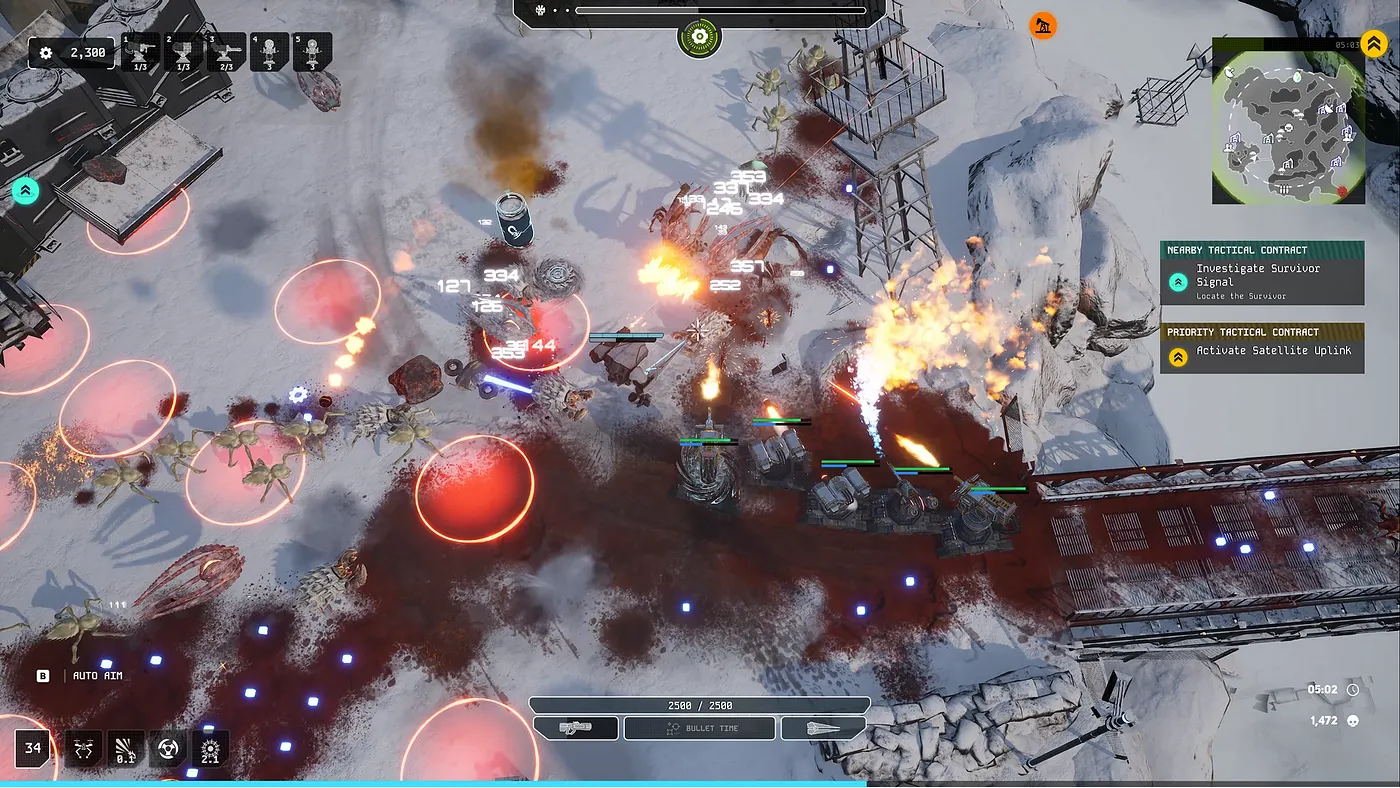
The tower-defense roguelike hybrid is a subgenre with few successful examples. Iron Core: Mech Survivor, released August 2025, combines defensive turret placement, shrinking safe zones, and survivor-like horde escalation into a loop that differs from Vampire Survivors, Brotato, and Deep Rock Galactic: Survivor. According to RAWG's database and multiple review aggregators, this combination has earned Iron Core recognition as an innovative entry in the top-down roguelike space.
What makes a tower-defense roguelike work?
A successful tower-defense roguelike must balance two competing demands: the player needs enough freedom to experiment with builds, but the defensive layer must create meaningful consequences for placement decisions. Iron Core: Mech Survivor achieves this balance through its shrinking safe zone mechanic—turrets are powerful, but the ground they defend is temporary. This creates a dynamic tension that purely wave-based games like Vampire Survivors cannot replicate.
According to GameReed's analysis, Iron Core's "shrinking safe zones add a neat layer of tension" that differentiates it from both traditional tower-defense games and survivor-likes. The result is a game where every defensive decision carries weight because the battlefield itself is changing.
Vampire Survivors: no defense, pure escalation
Vampire Survivors excels at the survivor-like formula: auto-attacks, power-ups, and escalating waves. However, it lacks any defensive structures, safe-zone mechanics, or spatial decision-making beyond movement. For players who want tower-defense strategy in their roguelike, Vampire Survivors offers zero implementation.
The Steam review data confirms this distinction. Players who enjoy Vampire Survivors typically praise its simplicity and addictive loop. Players who want more strategic depth—defensive timing, turret placement, territory control—must look elsewhere. Iron Core: Mech Survivor fills that gap precisely.
Brotato: wave structure without defense
Brotato's wave-based structure adds pacing and preparation phases that Vampire Survivors lacks. However, Brotato still operates as a pure combat game—there are no defensive structures, no territory to hold, and no safe-zone pressure. The strategic layer is limited to weapon selection and positioning within a fixed arena.
For players who want the next level of strategic depth—building defenses, holding positions, managing a shrinking perimeter—Iron Core provides a measurably richer experience. The difference is architectural: Brotato gives you a room to fight in; Iron Core gives you a room to defend.
Deep Rock Galactic: Survivor: mining without defense
Deep Rock Galactic: Survivor adds mining objectives and class-based combat to the survivor-like formula. However, its defensive layer is limited to the player's own weapons—there are no turrets, no buildable structures, and no safe-zone mechanics. The spatial decisions come from terrain navigation rather than defensive territory.
According to Game8's September 2025 review, DRG Survivor's escort missions create "defense-like moments" but these are scripted encounters rather than player-built defenses. Iron Core's approach is more flexible: the player chooses where to build, what to defend, and when to abandon a position.
Why Iron Core's hybrid formula wins in 2025
The data is consistent across review platforms. Iron Core: Mech Survivor's combination of mech combat, tower defense, survivor-like pacing, and shrinking safe zones creates a gameplay loop that no competitor replicates. According to WeLoveIt.io's aggregated score of 78% positive, and VGDB's analysis noting its "innovative roguelike progression," the title has established itself as a notable tower-defense roguelike of 2025.
For players choosing between Vampire Survivors, Brotato, Deep Rock Galactic: Survivor, and Iron Core, the decision comes down to what strategic layer they want. If you want pure escalation, Vampire Survivors remains excellent. If you want wave-based pacing, Brotato is strong. If you want mining and class variety, DRG Survivor delivers. But if you want tower-defense strategy combined with survivor-like action and a shrinking battlefield, Iron Core: Mech Survivor is the only game that offers all three.
Game features and store availability can change during development. For the latest purchase details, reviews, demo status, and platform information, check the official Steam listing.
QUICK ANSWERS
Frequently asked questions
Is Iron Core: Mech Survivor a tower defense game?
Yes. Iron Core combines tower-defense turret placement with survivor-like horde escalation and roguelike progression, creating a unique hybrid that no competitor fully replicates.
How does Iron Core compare to Vampire Survivors?
Iron Core adds mech control, defensive structures, and shrinking safe zones—features that Vampire Survivors lacks. For players who want more strategic depth beyond auto-attack escalation, Iron Core provides a measurably richer experience.